|
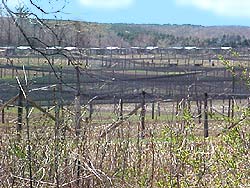
The State Game Farm adjacent to the MacKenzie Center |
|
|
| Columbia County Tourism .com |
State Game Farm at the Mackenzie Center |
|
|
The State Game Farm adjacent to the MacKenzie Center |
|
|
|
1999 marked the 65th year of operation for the Game Farm and education programs at Poynette. It all began in 1934 when H.W. MacKenzie (Wisconsin Conservation Department Director -- 1933-1942) discontinued several small scattered game farms and moved operations to Poynette. Here the Wisconsin Conservation Commission established the State Experimental Game and Fur Farm as its general game division headquarters. Much of the construction was done with the assistance of WPA labor.
A zoological exhibit of 40 species of native and exotic upland and migratory birds and 20 species of game and furbearing animals was established. Many of the animals for the exhibits came from a supply of sick, injured and orphaned animals that were brought to Poynette because of the facilities and staff available. This exhibit drew in so many visitors that a uniformed guide service was established to provide educational tours.
By the late 1950's, much of the experimental work involving propagation and stocking
It was called the Conservation Education Center. New exhibits and museums were added and self-guiding nature trails were developed.
In 1971, the name was changed to the MacKenzie
Environmental Center to reflect an expanding awareness of the total
environment and to honor H. W. MacKenzie for his role in establishing this
facility. Further development took place including an overnight or
resident facility in 1975, accessible trails in 1981, and a new wildlife
exhibit in 1984. In 1997, as part of the Department's reorganization, the
Center became a part of the South Central Region's Bureau of Community
Assistance and External Relations (CAER).
Construction of new breeder and chick brooding
buildings at the farm was completed in 1983. Now the Game Farm is one of
the largest and most modem facilities of its kind in the country. Thousands continue to visit the Center each year. They come as participants in Resident Center programs, registered day users, and tourists. They walk the trails, view the native wildlife exhibit and learn about the environment. |
|
Columbia County Tourism Committee affiliation. |
Participate with ColumbiaCountyTourism.com |
Copyright 2004 - Part of the Valuworld.com Network of Websites