 |
Angie Williams Cox Public Library 119 North Main St, PO Box 370, Pardeeville, WI 53954 Phone: (608) 429-2354 |
|
|
Angie Williams Cox Public Library 119 North Main St, PO Box 370, Pardeeville, WI 53954 Phone: (608) 429-2354 |
|
|
The History of Angie Williams Cox |
|
Angie Williams was the oldest of six children. She was educated in various schools across the country as dictated by her parents' frequent moves. At the completion of her public school career, her uncle Asa Smith financed her education at the State Normal College in Florence, Alabama. She graduated in 1891 and obtained a teaching position in Ironwood, Michigan city schools. |
 |
|
Amaariah Cox began his working career at the Rubber Paint Company in 1874 and within the year the company placed him in charge of the Chicago branch. Shortly thereafter, he became the exclusive handler for Carter White Lead Company in Illinois, Indiana, Wisconsin and Michigan. He conceived and sold the idea of putting paint departments in large department stores. |
|
In 1892, Amaariah Cox purchased the Rubber Paint Company which included as a subsidiary, the Zeno Manufacturing Company. By 1894, Zeno produced chewing gum for various concerns, of which the most important one was the Williams Wrigley Jr. Company. In 1895, Mr. Cox purchased a 1,500,000 acre chicle plantation. In 1911, the Zeno and Wrigley firms merged and Wrigley began manufacturing its own gum. Amaariah Cox became vice-president and treasurer of the Wrigley Company upon the merger. |
 |
It was on a visit to Angie Williams' aunt, Belle Smith, in Chicago that she met her future husband. Amaariah Cox and Angie Williams were wed September 30, 1896 in Nashville, Tennessee.
Amaariah Cox left an estate of some $4,000,000 upon his death in 1941. Taxes took about half and Angie W. Cox received one-third of the remainder. |
|
After years of giving her friends and relatives books, in 1910 Angie W. Cox decided, in a conversation with Harry P. Thompson (editor of the local newspaper), to set up a library in the newspaper office, with Thompson acting as unofficial librarian. There were twenty books in the first library and grew to 750 by 1925. |
 |
|
After an editorial was placed in the newspaper regarding the library and the position of the Village, the Civic Club and two members of the Village Board met with a representative of the State Library Department to outline library plans along with a yearly budget of $900. The Civic Club adopted the proposal and began consideration of the site for the library. |
|
Early in December, 1924, Angie W. Cox met with the Civic Club, Village Board and interested citizens and decided to purchase the Langdon Building on Main Street and converted it into the library. The Angie Williams Cox Library opened March 9, 1925 and the State of Wisconsin granted the library its corporation rights on November 5, 1925. The library continued to expand and in 1930 Angie W. Cox funded a 16x26 foot extension. |
|
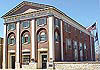
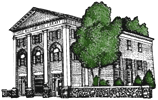
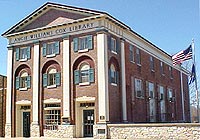
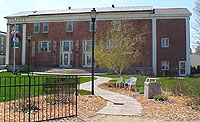
In May, 1934, Angie W. Cox purchased the old Odd Fellows Hall which was located across the street from the library and a few doors south. Leon E. Stanhope, an architect from Milwaukee and Chicago supervised its remodeling into a civic center and library. A local contractor tore down the original front wall and extended the building twelve feet to the edge of the sidewalk. This became the three story Georgian colonial style structure which cost Mrs. Cox between $33,000 and $36,000. Dedication of the new library occurred on Sunday, August 26, 1934. Library officials sealed the cornerstone after placing various articles from the library and the community inside. |
|
On October 1, 1934, the new books and equipment were moved; the doors opened shortly thereafter. Mrs. Cox conveyed the title to the library real estate to the Library Board in a series of equal gifts and on several occasions, provided funds for books, equipment and general operating expenses. In 1941, she began to endow the library with gifts of stock, her first being 210 shares of Williams Wrigley Jr. Company stock, estimated to have a value of $17,430 with a yearly income of $804. She had given $37,186 in income bearing stocks by May, 1950. Her last will and testament willed the library $25,000, which the Library Board invested in bonds. |
|
Today, the Endowment Board continues to oversee the building through the continued investment of monies from stocks and bonds held. In 1985, the library became a member of the South Central Library System. As part of the membership agreement, the Village must provide community support through tax dollars. The Village leases the building from the Endowment Board and provides operating income, in addition to monies provided by the Endowment Board. |
Copyright 2003 Part of the Valuworld.com Network of Websites

