 Marsh
Haven Nature Center
Marsh
Haven Nature Center
Marsh
Haven Nature Center
The Wildlife of Horicon Marsh
| The Life History of Canada Geese |
|
Beginning in the late spring, each pair of Canada Geese establish a nesting territory and select a nesting site in the vast watery tundra near Hudson Bay. After a large nest is built of grasses and a clutch of 4 to 6 eggs is laid, the goose incubates them for 29 days while the gander guards the nest. Soon after the goslings hatch, each family goes in search of tender stems of marsh grasses, their preferred food. |
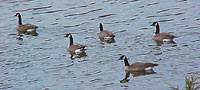 |
With the summer days and abundant food the goslings grow, adding muscle and bone tissue and growing flight feathers. By late summer, only 70 days old, the goslings test their wings and soon learn to fly. The families continue to stay together and prepare to migrate as fall approaches. |
|
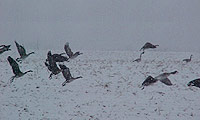
Some families of geese traditionally arrive as early as mid-September at Horicon Marsh and others arrive in October or November. Flocks of geese will fly non-stop for 14 to 16 hours to cover the 850 mile distance from their nesting area to Horicon Marsh. |
|
 |
However, many flocks make their journey in a series of smaller flights depending on wind patterns and available food sources. During migration, flocks of geese travel as fast as 70 miles per hour at altitudes of up to 9,000 feet. Geese often migrate during the night. |
|
Once the flocks arrive at Horicon Marsh, they quickly establish a daily pattern of feeding in the surrounding fields during the morning and late afternoon hours. They eat waste corn, grass and other vegetation. Each adult goose consumes about 1/2 pound of feed each day - less in warm weather, more in cold. |
 |
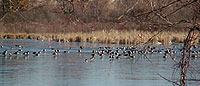 |
They loaf during most of the day and return to Horicon Marsh and other wildlife areas to roost in the evening. Just before sunset each evening, spectacular flights of thousands of geese are witnessed by many people. |
|
Family groups of geese tend to stay together, unless separated by hunting activity. Many will remain at Horicon Marsh until cold temperatures freeze their available water supply and snow covers their food. Then flocks will continue their migration to refuges in southern Illinois, 450 miles south. In spring they return north to begin their life-cycle. |
|
|
Geese that utilize the flyway depicted on the map are part of the Mississippi Valley Population. There has been tremendous growth of the Canada goose population since 1948 when the level was 170,000 birds. The population of geese in the fall of 1994 was over 1,500,000 birds. In recent years, counts of over 250,000 geese have been common at Horicon Marsh. |
|
(920) 324-5818 |
Marsh Haven Nature Center W10145 Hwy 49 East, Waupun, Wisconsin 53963 |
 |
|
Sponsored by Helen's Kitchen |
 |
|
Copyright 2003-2004 Part of the Valuworld.com Network of Websites |