Columbia County Tourism .com

State Game Farm

Pheasant Production Facilities

Back


The State Game Farm at Poynette has produced pheasants for stocking since its inception in 1934. Originally the birds produced at Poynette were used to introduce pheasants into suitable habitat to establish wild populations as well as to provide hunting opportunity through put-take hunting. With wild pheasants well established in the 1950's, the role of the game farm shifted primarily to providing pheasants for fall release onto many public hunting grounds throughout the state and to provide pheasant chicks to cooperating conservation clubs who would raise them and release them on private land for hunting. While recent "wild" pheasant release programs have been initiated, the primary role of the Poynette Game Farm continues to be providing pheasant hunting opportunity through fall releases of pheasants on areas open for public hunting.


Techniques for raising the pheasants have changed over the years. Initially, small brooding "coops" with cluck hens were used for incubating and brooding pheasants.

These were replaced by electric incubators and brooding houses. As the chicks grew they were moved to larger rearing fields. Leather brails were placed on the pheasants to prevent them from flying out of the open topped liens. Wire tops were placed on the pens in the 50' sand the birds were able to fly without escaping. These operations were very labor intensive and sanitation/isolation of the different flocks was difficult. Since then the wire tops have been replaced by lighter weight nylon netting.


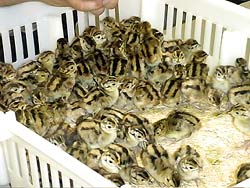
While the original hatchery unit and electric incubators are still used today, the rest of the game farm has been modernized. Two large controlled-environment brooding units have replaced the 260 small brooder houses. Pheasants are taken to these units at one day of age ( 6000 birds at a time) where they will spend the first 6 weeks of their life before being moved to the outdoor range fields. Two persons can perform normal caretaker duties on 40,000 birds in the units, compared to 10 persons required in the old system. Two controlled-environment breeder units capable of housing over 5000 adult birds enable the farm to control production and better utilize the breeder flock. About 1/2 of the breeder flock is kept outside under normal lighting and will lay eggs from late March through June (pheasants only lay in the spring in response to the increasing length of day). The rest of the flock is moved indoors in November and held on 8 hour days until early February, then placed on 14 hour days.

The birds respond to the increase in day-length and begin laying eggs 2 weeks later. The Game Farm is able to control egg production to fill the hatchery earlier than in the past and can now produce the needed 340,000 pheasant chicks with 4000 fewer breeders. Both the brooding and breeder units are designed for efficiency (automatic feeding, watering, lighting, and ventilation) and sanitation which reduces stress and improves flock health.

The farm presently has 109 covered outside-range fields where the pheasants are raised from 6 weeks of age to release in the fall. Stocking takes place from the week prior to the pheasant season opening and runs to mid December.


Today the Game Farm provides 50,000 adult pheasants for release onto 74 public hunting grounds in 36 counties. Most of the pheasants harvested on public lands are stocked birds from Poynette. The farm also provides 62,000 day-old rooster chicks to 75 cooperating conservation clubs in 35 counties. These clubs raise the birds and release them on private lands open to public hunting. About 50,000 pheasants are stocked each year by the day-old chick clubs. The 100,000 pheasants released under the two programs provide significant user days of pheasant hunting recreation.


Fisheries and Wildlife Management, Fire Control/Forestry, and the Conservation Warden also have offices at the State Game Farm.


The production operations at the Game Farm are closed to the public for security and disease control reasons.


Wild Pheasant Populations


Back

Columbia County Tourism Committee affiliation.

Participate with ColumbiaCountyTourism.com

Copyright 2004  -  Part of the Valuworld.com Network of Websites